

COBOD's 3D construction printing technology is supporting the restoration of marine biodiversity in Danish harbours.
A large-scale deployment of artificial reef modules, printed on a COBOD BOD2 printer, has occurred, with several installations at harbours across the country. COBOD has worked with StoneReefs on the project.
Modern ports rely on vertical steel sheet pile walls that are efficient for docking but harsh on marine ecosystems. Using 3D printing, StoneReefs has produced reef-textured concrete modules that mount seamlessly onto these quay walls, with layered surfaces, grooves and cavities creating micro-habitats that support smaller marine organisms. Within only a few months underwater the modules attract algae, mussels and smaller fish and in Fredericia harbor even cod and eel have returned.
3D printing is said to have been a cheaper and easier method of manufacture for these structures, while the use of CO₂-reduced cement and local aggregates combined with a proportion of crushed mussel shells have helped larvae settle and speed up colonisation.
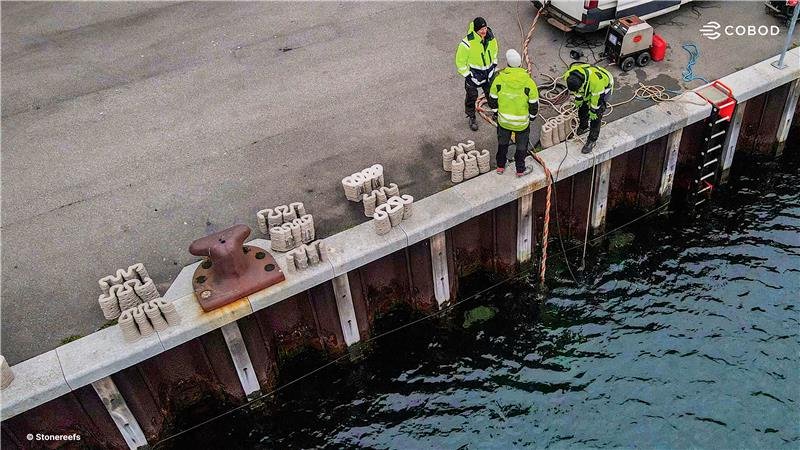
“3D printing lets us improve biodiversity without disturbing harbour activities” said Mikkel Brich, co-founder and CEO of 3DCP Group and StoneReefs. “We make modules that match the wall geometry to not interfere with daily operations but provide the textures marine life needs. We experience that when you give nature a foothold life, returns within months.”
Henrik Lund-Nielsen, Founder and General Manager of COBOD International, added: “It is great to see our 3D construction printing technology at work just around the corner from our headquarters in Nordhavn Harbor. Stonereefs shows the benefits of our technology including the design freedom, material flexibility through our open materials approach and scalability. These strengths can be applied to many offshore and marine applications that help restore biodiversity. The project demonstrates how construction technology can serve both industry and nature, with potential for wider marine and offshore applications.”
Recently, COBOD's 3D construction printing technology was used to build two fire-resistant houses in Colorado.


