AM is often seen as an expensive endeavour – but does it have to be?
Gravity Pull Systems Partner Huba Horompoly thinks not. At RAPID + TCT, he will introduce an optimisation-based production planning approach, exemplified by the SYNOPTIK system, which allows manufacturers to set cost minimisation as a primary objective.
The company is offering this cost-optimisation solution 'free of charge for anyone who wants to explore it,' with Horompoly keen for the RAPID + TCT presentation to be about sharing a 'capability that could benefit the entire AM community.'
Ahead of the presentation, Horompoly sat down with TCT to discuss the optimisation-based production planning approach, sources of inefficiency, and what's been holding AM users back when it comes to cost-effective workflows.

TCT: Tell us about the SYNOPTIK production planning system and how you hope it can provide value to those using AM?
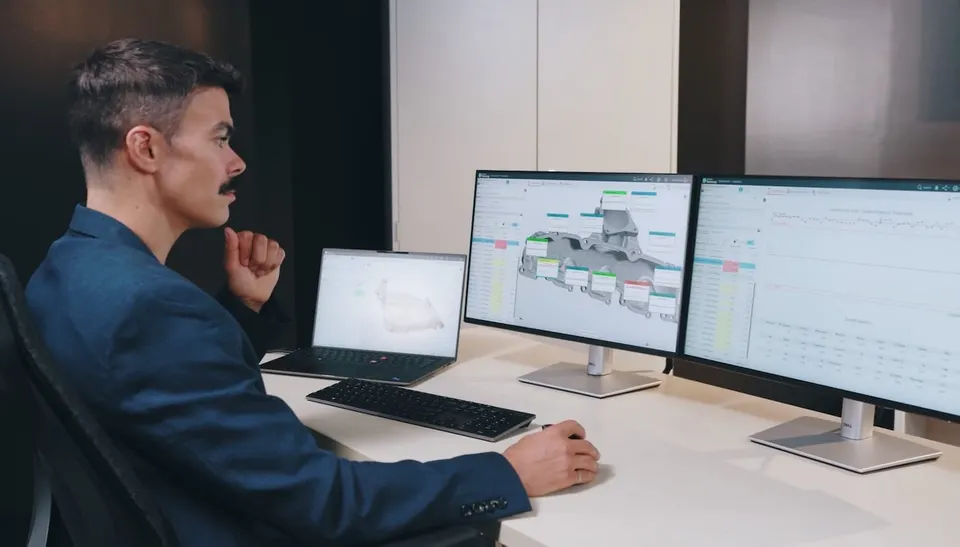
Huba Horompoly [HH]: SYNOPTIK is a production planning and scheduling optimiser built specifically for the operational realities of additive manufacturing. What makes it different from conventional planning tools is that it treats the entire production chain — from order intake through nesting, printing, post-processing, materials management, and delivery — as a single, interconnected optimisation problem. Most planning approaches address these steps sequentially and in isolation, which means they consistently leave value on the table.
The engine underneath is a combination of heuristics, self-developed algorithms for solving what are technically NP-hard scheduling problems, and statistical process control that enables the system to continuously learn and discover new cost-reduction rules. It is also agile by design: it listens to real-time events — an urgent order, a machine going down, a material shortage — and re-optimises accordingly.
In practical terms, we have demonstrated cost savings of 15–30% in real production environments, with no additional hardware investment required. The system is also configurable to optimise for multiple objectives simultaneously: cost, CO₂ emissions, delivery time, or any weighted combination. That last capability has become increasingly important as our customers face pressure to demonstrate sustainability progress without sacrificing profitability.
TCT: Without giving too much away, what is the single biggest source of inefficiency that manufacturers often overlook when it comes to deploying AM?
HH: The assumption that you can optimise AM production one step at a time.
It sounds obvious once you say it, but it is deeply embedded in how most AM operations are run. Teams optimise nesting. Then they optimise post-processing. Then they look at materials management. Each step in isolation, each time missing the interactions between them.
Here is a concrete example: the nesting configuration that minimises material waste on the build plate may be exactly the wrong configuration for your heat treatment furnace downstream. What you gain in print efficiency, you lose in post-processing — and you never see it because you are not looking at both simultaneously. The same logic applies to powder recycling decisions, machine selection, print speed settings, and job scheduling.
AM is fundamentally different from subtractive manufacturing in one critical way: its cost drivers are variable. The dominant cost driver shifts from job to job depending on the geometry, material, machine, and order mix in play. That variability is actually AM's greatest operational asset — but only if your planning system is designed to exploit it dynamically. Most are not.
"15–30% cost reduction in AM operations is achievable today, with the machines and materials you already have."
TCT: If intelligent planning can make AM operations significantly more profitable, why hasn't this kind of approach become standard practice already? What's been holding it back?
HH: Three things, in my experience.
First, the problem is genuinely hard. Holistic AM scheduling is mathematically an NP-hard optimisation problem — meaning the number of possible combinations explodes exponentially as you add parts, machines, materials, and constraints. Conventional optimisation approaches either simplify it to the point of uselessness or take too long to run. Building algorithms that produce good solutions fast enough to be operationally relevant took us years of development.
Second, there has been a tendency to import planning frameworks from subtractive manufacturing directly into AM. In subtractive, the right approach is stability: lock in your process parameters, standardise, and distribute fixed costs across volume. In AM, that instinct actively works against you. The economies of scale in AM come from embracing variability and dynamism — not from eliminating them. Recognising that requires a genuine shift in thinking.
Third — and perhaps most practically — the data infrastructure in many AM operations is not yet mature enough to feed a sophisticated optimiser. You need reliable cost rates, energy consumption data, materials tracking, machine availability data. Many facilities are still building that foundation. The good news is that threshold is lower than people think, and the payback is fast once you cross it.
TCT: What is the key learning you're hoping to convey through your presentation at RAPID+TCT?
HH: Two things, which I hope will surprise people in different ways.
The first is that 15–30% cost reduction in AM operations is achievable today, with the machines and materials you already have. The inefficiency is not in the hardware — it is in the planning. That is a message with immediate, practical implications for anyone running an AM operation at scale.
The second is more nuanced, and I think more interesting. There is a widespread assumption in the industry that sustainability goals and profitability goals are in tension — that reducing your CO₂ footprint means accepting higher costs. Our data shows this is simply not true in the majority of AM operational scenarios. Cost-optimised schedules and CO₂-optimised schedules yield results that are strikingly close to each other in most cases. The single most powerful lever for reducing CO₂ in metal AM — maximising powder recycling — also reduces costs. These objectives are natural allies far more often than they are adversaries.
Where genuine trade-offs do exist, I want to give people the tools to see them clearly and quantify them precisely — not guess at them. The goal is conscious decision-making, not ideology in either direction.
TCT: And who should attend your session?
HH: Anyone who is responsible for the economic performance of an AM operation — or for making the business case for expanding one.
That includes operations managers and production planners at AM service bureaus and in-house manufacturing facilities, particularly those running metal powder bed fusion at any meaningful scale. It also includes the CFOs, COOs, and business unit leaders who are being asked to justify AM investment decisions or who are trying to understand why their AM operation is not yet as profitable as projected.
If you are evaluating whether to add machines, whether to bring production in-house or outsource it, whether AM is more or less cost-effective than a subtractive alternative for a specific product, this session will give you a framework and real data to think about those questions more rigorously.
And if you have been told that making your AM operation more sustainable will cost you money, I would especially encourage you to come. You may be pleasantly surprised.

Cost-Driven Planning: Maximizing Profit in Additive Manufacturing | Huba Horompoly | Gravity Pull Systems